Thursday, 31 January 2013

Statistics On Tobacco


Statistics On Tobacco Detail
Regular measurements of the prevalence of tobacco use by the Canadian population are obtained by the Canadian Tobacco Use Monitoring Survey (CTUMS), for those aged 15 years and older, and the Youth Smoking Survey (YSS), for school-aged children in grades 6-12. All pertinent information for CTUMS and YSS can be found in this section.Monitoring and analyzing tobacco stats helps us keep track of our successes in the tobacco field – and points us towards where we need to do more work.
Statistics On Tobacco

Organic Tobacco

Organic Tobacco Detail
The Santa Fe Natural Tobacco Company sells cigarettes under the brand name American Spirit®, which appear to blatantly appeal to the public's growing interest in all things green. The way American Spirit cigarettes are marketed is that they are "100% Additive-free Natural Tobacco" or "100% Organic Tobacco" cigarettes. These two cigarettes came out just about the same time the green movement started gaining some momentum. Have the makers of these "natural" and "organic" cigarettes taken advantage of the green movement that's underway? Who allows the makers of American Spirit cigarettes to advertise its cigarettes as "natural" and "organic?" Why is the Santa Fe Tobacco Co. allowed to advertise its American Spirit cigarettes as "natural" and "organic?" Finally, does an organic tobacco cigarette or a 100% additive-free natural tobacco cigarette mean it's a better, even a safer cigarette, for you than other cigarettes that aren't natural or organic tobacco? Let's take the first question, first: has the Santa Fe Natural Tobacco Company, makers of the cigarette branded American Spirit, taken advantage of the green movement that's underway? To answer the question, you have to ask a couple of other questions: why would the Santa Fe Natural Tobacco Company label its cigarettes "natural" and "organic" in the first place; if there wasn't a green movement afoot, would the Santa Fe Tobacco Company bothered with marketing a "natural tobacco" and "organic tobacco" cigarette, especially in the light the times were a-changing southward fast for tobacco companies in the U.S. when Santa Fe Natural Tobacco Co. introduced its new cigarettes.
Organic Tobacco
Organic Tobacco
Organic Tobacco
Organic Tobacco
Organic Tobacco
Organic Tobacco
Organic Tobacco
Organic Tobacco
Organic Tobacco
Organic Tobacco
Organic Tobacco
Organic Tobacco

Tobacco Smoke


Tobacco Smoke Detail
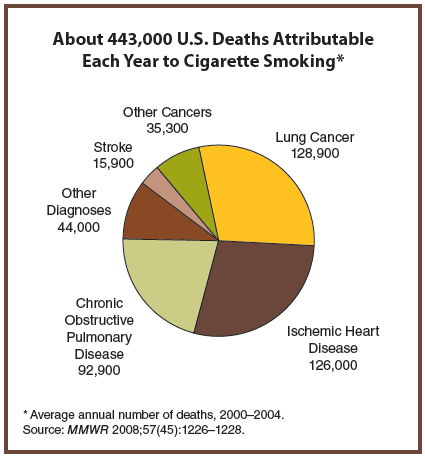
Smoking is the number one cause of preventable death in the U.S., with 443,000 deaths, or 1 of every 5 deaths, in the United States each year. And, there are 123,000 lung cancer deaths annually attributed to smoking cigarettes. Nearly 1 of every 5 deaths is related to smoking, more than alcohol, car accidents, suicide, AIDS, homicide, and illegal drugs combined.
In addition to smokers, those exposed to secondhand or side-stream smoke have been shown to risk disease as well. In some studies, it has been found that side-stream or secondhand smoke is two to five times more concentrated in some carcinogens than the mainstream smoke inhaled by a smoker. Each year, approximately 3,400 nonsmoking adults die of lung cancer as a result of breathing the smoke of others’ cigarettes. Environmental tobacco smoke also causes an estimated 46,000 deaths from heart disease in people who are not current smokers. Secondhand smoke contains over 4,000 chemical compounds, including 69 known carcinogens such as formaldehyde, lead, arsenic, benzene, and radioactive polonium 210.
Tobacco Smoke
Tobacco Smoke
Tobacco Smoke
Tobacco Smoke
Tobacco Smoke
Tobacco Smoke
Tobacco Smoke
Tobacco Smoke
Tobacco Smoke
Tobacco Smoke
Tobacco Smoke
Tobacco Smoke

Anti Tobacco Fact


Anti Tobacco Fact Detail
Nicotine affects the nerve-muscle junctions, causing tremors and shaking. Nicotine causes narrowing and constriction of the arteries, adding to the heart's load. Nicotine, through its ability to stimulate, causes excitement and anxiety. But the effect wears off, often a period of depression follows, whereupon another cigarette is taken. Nicotine, an insecticide, makes the blood more viscous and decreases the available oxygen. It also adversely affects the breathing, sweating, intestinal, and heart actions of our autonomic nervous system, probably due to hindering the blood flow to the nerve centers in the brain.
Two to four cigarettes in a row increase blood fats 200 to 400%. The average smoker (30 cigerettes per day) has 4 to 6 times the chance of having heart disease if he's in the 45-54 year age group.
If the mother smoked during pregnancy, her baby will average 6 ounces less and its pulse will be 30% faster than a non-smoker's baby, and there'll be withdrawal symptoms in the baby after birth. Premature birth has been related to smoking by the mother. There is a direct link between parents' smoking and children's respiratory disease.
Anti Tobacco Fact
Anti Tobacco Fact
Anti Tobacco Fact
Anti Tobacco Fact
Anti Tobacco Fact
Anti Tobacco Fact
Anti Tobacco Fact
Anti Tobacco Fact
Anti Tobacco Fact
Anti Tobacco Fact
Anti Tobacco Fact
Anti Tobacco Fact

Tabacco News


Tabacco News Detail
(NaturalNews) The vast majority of the $246 billion rolling settlement awarded to all 50 U.S. states as part of the 1998 Tobacco Master Settlement Agreement is apparently being spent on things other than the anti-smoking programs and campaigns for which the money was intended, according to a new report. Entitled Broken Promises to Our Children, the new report highlights the fact that, 14 years later, as little as two percent of the settlement money is actually going towards smoking prevention programs, while the other 98 percent is being funneled elsewhere into the unknown.
Each year, states are given varying amounts of the settlement money specifically to develop programs aimed at curbing tobacco use among citizens, and particularly among children. For the 2013 fiscal year, the states will collectively be given $25.7 billion in settlement revenues for the purpose of fighting smoking. But according to this latest report, which was issued by the Campaign for Tobacco-Free Kids, only about $460 million of this extremely large sum will actually be used for anti-tobacco purposes.
Tabacco News
Tabacco News
Tabacco News
Tabacco News
Tabacco News
Tabacco News
Tabacco News
Tabacco News
Tabacco News
Tabacco News
Tabacco News
Tabacco News